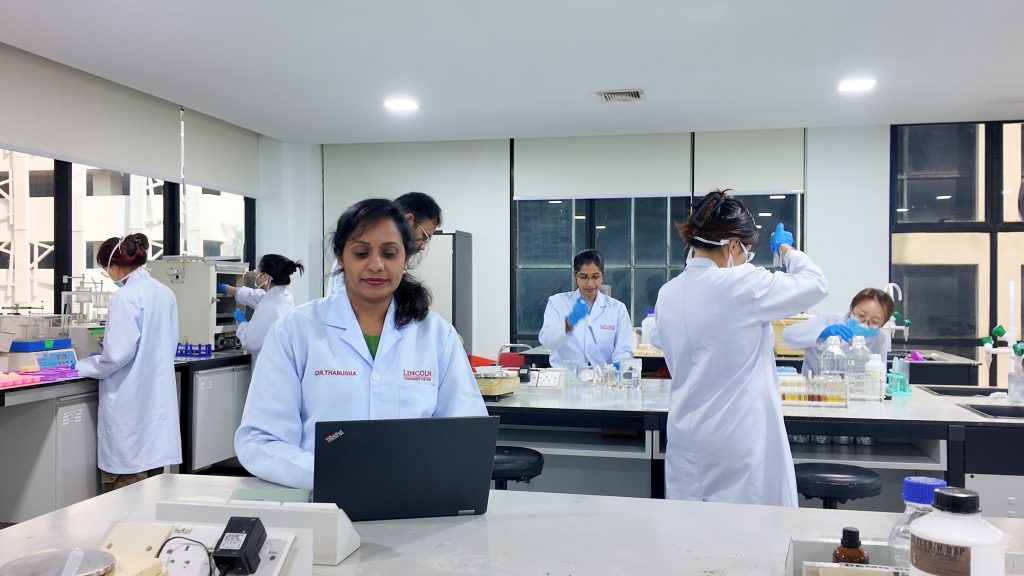
A significant milestone has been achieved at Lincoln University College (LUC) with the successful filing of a patent with the Intellectual Property Corporation of Malaysia (MyIPO) for a novel nanotechnology-based wound-cleansing formulation, developed through extensive laboratory research.
The project was carried out under the leadership and supervision of Prof. Satheesh Babu, with Dr. Thanusha Perera serving as the principal researcher, supported by the Faculty of Pharmacy research team. The study addresses one of the most persistent challenges in wound management—bacterial biofilms.
Biofilms are structured microbial communities that protect bacteria from antibiotics and the body’s immune defenses, leading to delayed healing and reduced treatment effectiveness in chronic wounds. While conventional wound cleansers can remove surface bacteria, they often fail to eliminate deeply embedded biofilms, resulting in recurrent infections. Effective disruption of biofilms is therefore critical to achieving improved wound-healing outcomes.
“Our aim was not just to clean a wound, but to remove the invisible barrier that prevents true healing,” Dr. Thanusha stated. “Nanotechnology gave us a powerful tool to deliver active compounds precisely where conventional products fail.”
The patented formulation integrates essential oils and enzymes within a nanotechnology-based delivery system to enhance antimicrobial activity and biofilm disruption. Laboratory investigations demonstrated a significant reduction in bacterial load, effective disruption of biofilm architecture, and degradation of key extracellular biofilm components. The nano-carriers further enhanced penetration into biofilm layers, improved enzyme stability, and enabled controlled release at the wound site.
Both in vitro and in vivo evaluations produced encouraging results, confirming the formulation’s safety and its ability to support improved wound-healing outcomes. These findings highlight the formulation’s strong potential for future clinical application.
In comparative laboratory studies, the formulation achieved nearly 80% biofilm inhibition within a relatively short time, significantly outperforming several commonly used marketed wound-cleansing products.
“The speed and strength of the response were remarkable,” Prof. Satheesh emphasized. “Observing this level of biofilm disruption within minutes underscores the scientific value and clinical promise of the formulation.”
The research journey was not without challenges. Optimizing nano-carrier systems, balancing enzyme stability with antimicrobial efficacy, and achieving maximal biofilm disruption required extensive experimentation, repeated trials, and meticulous validation.

Reflecting on the journey, Dr. Thanusha Perera shared:
“At the end of each long day, what kept us moving forward was purpose. We believed this work could one day help patients suffering from chronic wounds, and that belief pushed us past every challenge. In the end, we were able to transform an idea into an evidence-based innovation.”
Summing up the journey, Prof. Satheesh added:
“This accomplishment demonstrates how curiosity, persistence, and scientific rigor can lead to meaningful breakthroughs. The successful MyIPO patent filing reflects months of dedicated research and further strengthens Lincoln University College’s reputation as a center of excellence in pharmaceutical and biomedical innovation.”

The patent marks the beginning of the next phase of development—further refinement, advanced validation, and translation into a clinically viable product. Lincoln University College is actively seeking potential industry partners to collaborate on scale-up development, regulatory planning, and commercialization pathways, with the goal of translating this innovation from the laboratory to real-world clinical applications.
This achievement continues to inspire students and researchers alike, reinforcing Lincoln University College’s leadership in impactful research and its commitment to advancing healthcare solutions.